
If you’re searching for real answers about sleep for athletic recovery, you’re likely looking to train harder, recover faster, and perform at your peak without burning out. The truth is, no supplement, workout split, or recovery gadget can replace the biological power of quality sleep. It’s during deep sleep that muscle tissue repairs, growth hormone is released, and your nervous system resets after intense training.
In this article, we break down exactly how sleep impacts muscle repair, endurance, reaction time, and injury risk—and what you can do to optimize it. We draw from established sports science research, performance physiology principles, and practical recovery strategies used in high-performance training environments.
Whether you’re an endurance athlete, strength trainee, or competitive performer, you’ll learn how to structure your sleep routine to maximize adaptation, reduce fatigue, and support consistent progress. If better recovery and improved performance are your goals, it starts here.
Training harder isn’t the breakthrough you think it is. Recovery is. Here’s the comparison:
- More Miles, Less Sleep: You stack workouts, chase soreness, and brag about five-hour nights. Result? Elevated cortisol, stalled muscle protein synthesis, slower reaction time (yes, even if you “feel fine”).
- Smarter Training, Deeper Sleep: You protect seven to nine hours. Growth hormone surges during slow-wave cycles, repairing fibers and restoring glycogen, while REM sleep locks in motor patterns like a nightly software update.
Studies show sleep restriction reduces performance and accuracy (Journal of Sports Sciences). Use sleep for athletic recovery and plateau becomes progress.
Sleep isn’t downtime; it’s your body’s most advanced performance lab. During sleep, you cycle through four stages: NREM 1, NREM 2, NREM 3, and REM. NREM 1 and 2 act as the on-ramp, slowing heart rate and preparing tissues for repair.
Deep Sleep (NREM 3) is the true goldmine. In this stage, blood flow to muscles increases, delivering oxygen and amino acids that drive tissue repair, muscle growth, and bone remodeling. Growth hormone peaks here, which is why cutting sleep short blunts recovery (yes, even if your workout was perfect).
REM sleep is the brain’s training ground. It consolidates motor skills, meaning your brain rehearses new movement patterns and locks them in for tomorrow’s session. That’s why sleep for athletic recovery isn’t optional; it’s strategic.
Finally, consider glycogen—the stored carbohydrate that fuels intense effort. Research shows sleep deprivation reduces glycogen re-synthesis, leaving you underpowered for the next workout (like starting a race on half a tank). Prioritize seven to nine hours, keep a consistent schedule, and treat bedtime like training. Your performance tomorrow depends on what happens tonight. Protect it the way you protect your workouts, nutrition, and recovery protocols. Consistency compounds into measurable gains over time. And resilience.
Hormonal Harmony: How Sleep Regulates Your Inner Chemistry
Most athletes focus on macros and mileage. Few focus on hormonal timing—when your body releases the chemicals that actually rebuild you.
The Growth Hormone (HGH) Surge
Up to 75% of daily human growth hormone is released during deep sleep (National Institutes of Health). HGH drives protein synthesis, the process of building new muscle proteins to repair micro-tears created during training. Miss deep sleep, and you blunt the very signal that tells muscle to grow. (It’s like going to the gym and forgetting to clock in.)
Cortisol vs. Testosterone
Sleep deprivation elevates cortisol, a catabolic hormone that breaks down tissue for energy, while suppressing testosterone and IGF-1—key anabolic drivers of strength and recovery (Journal of Clinical Endocrinology & Metabolism). Some argue one bad night won’t matter. True. Chronic restriction? That’s where progress stalls.
Leptin and Ghrelin: Hunger Regulators
Poor sleep lowers leptin (fullness hormone) and raises ghrelin (hunger hormone), increasing cravings for high-carb, low-nutrient foods (PLOS Medicine). That’s why willpower feels weaker after short nights.
Inflammation Control
Deep sleep regulates cytokines, proteins that manage inflammation, accelerating soreness reduction (Sleep Foundation).
Pro tip: Treat sleep for athletic recovery like a training block—scheduled, protected, non-negotiable. Even LeBron tracks his hours. Your hormones are watching.
The Athlete’s Prescription: How Much Sleep Do You Really Need?
Moving Past the 8-Hour Myth
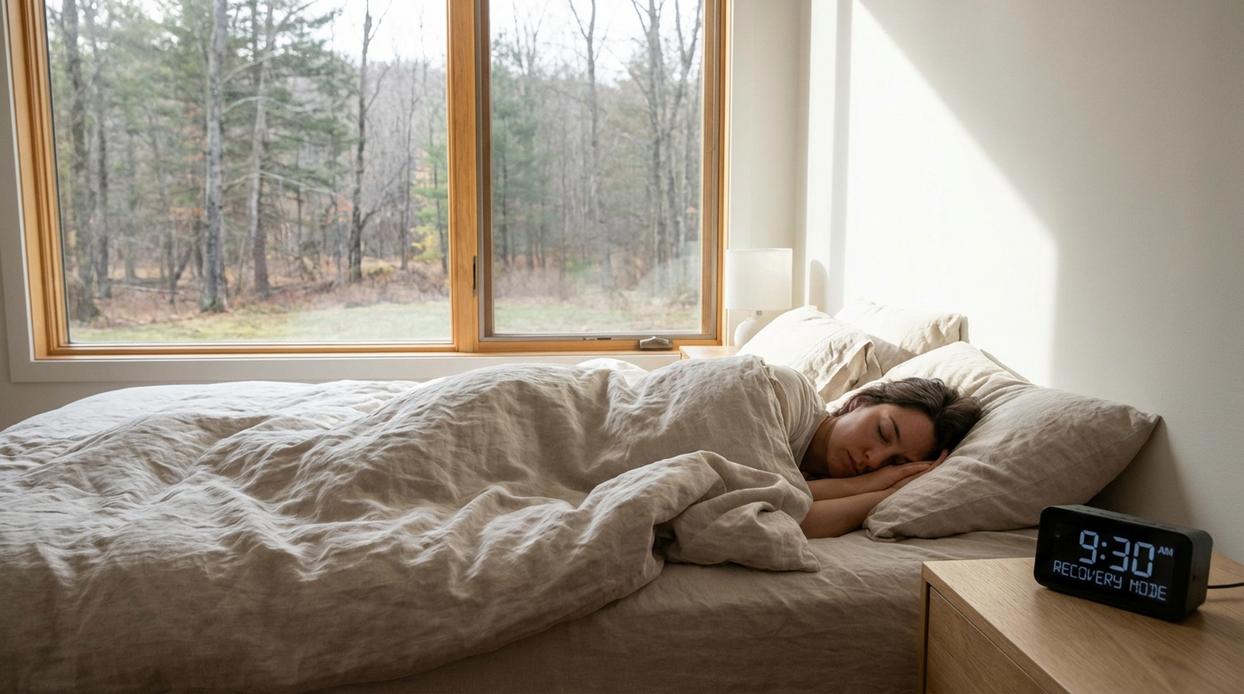
We’ve all heard it: “Just get eight hours.” Solid advice—if you’re not running hill sprints at dawn. While 7–9 hours works for the general population (National Sleep Foundation), athletes in heavy training often need 9–10 hours. Why? Training creates microscopic muscle damage and hormonal stress that only deep sleep can repair. In other words, your bed is basically a legal performance enhancer.
Sleep extension—sometimes called “sleep banking”—means intentionally getting extra sleep during intense blocks. Stanford research found basketball players who extended sleep improved sprint times and shooting accuracy. Not magic. Just biology.
And yes, naps count. A 20–30 minute power nap boosts alertness. A 90-minute nap completes a full cycle and supports sleep for athletic recovery—without the groggy, “what year is it?” feeling.
Track mood, performance, and morning HRV to gauge recovery. If metrics dip, your body’s waving a tiny white flag.
Pro tip: Pair quality sleep with smart fueling and the right hydration fundamentals for peak athletic function. Even superheroes need water.
Your Blueprint for High-Quality Recovery Sleep
Great performance starts long before your head hits the pillow. It begins with a shutdown routine—a deliberate 30–60 minute glide path into rest. Think dim lamps casting a warm amber glow, the faint rubbery scent of a foam roller, slow nasal breathing as you stretch tight hips. Read a physical book (yes, paper pages), journal, or try five minutes of meditation. These cues tell your nervous system it’s safe to power down. Some argue routines are rigid or unrealistic after late practices. Fair—but even 20 consistent minutes can condition your brain like Pavlov’s bell (minus the drool).
Next, build your “sleep cave.” Your room should feel cool and cocooned. Set the thermostat to 65–68°F (18–20°C) (National Sleep Foundation). Install blackout curtains; aim for pitch black where you can’t see your hand. Add a white noise machine or soft fan hum to blur sudden sounds. Pro tip: if travel disrupts you, pack a sleep mask and earplugs.
Manage light exposure like it’s part of training. Morning sunlight—bright, crisp, almost electric on your eyelids—anchors your circadian rhythm (Harvard Health). At night, block blue light from screens 1–2 hours before bed. Yes, even if the show ends on a cliffhanger.
Finally, time nutrition wisely. Eat 2–3 hours before bed; combine complex carbs and protein. Tart cherry, magnesium, and tryptophan-rich foods like turkey or nuts may support sleep (Journal of Medicinal Food). Prioritize sleep for athletic recovery, and your body will repay you in quieter heartbeats and steadier strides.
You’re not lazy—you’re under-recovered. I learned this the hard way after months of brutal training cycles and flat performances. I blamed programming, supplements, even genetics. The real culprit? Chronic sleep debt. I treated nights like downtime instead of strategy.
When I finally prioritized sleep for athletic recovery, everything shifted: steadier energy, better lifts, sharper focus.
Here’s what changed:
- A 30-minute shutdown routine
- Cooler, darker room
- Consistent sleep-wake times
Some argue hustle beats rest. I tried that. It backfired.
Start tonight. Pick one lever and pull it. Your body adapts when you let it. Fatigue is a silent performance killer. Period.
Build Stronger Performance Starting Tonight
You came here looking for real, practical ways to improve your performance, recover faster, and stop feeling stuck between workouts. Now you understand how training intensity, nutrition timing, hydration, mobility work, and especially sleep for athletic recovery all work together to determine your results.
The truth is, most athletes don’t struggle from lack of effort — they struggle from incomplete recovery. Soreness that lingers, stalled progress, low energy, and preventable injuries are all signs your body isn’t getting what it needs to rebuild stronger.
Here’s your next move: choose one recovery habit and implement it today. Prioritize consistent sleep, dial in post-workout nutrition, and schedule recovery as seriously as training. Small, consistent changes compound fast.
If you’re ready to train harder without burning out, follow our expert-backed guidance trusted by athletes who want smarter performance gains. Start applying these strategies now — your next breakthrough depends on it.
 Recovery & Endurance Training Specialist
Johnny Geraldeania has opinions about momentum moments. Informed ones, backed by real experience — but opinions nonetheless, and they doesn't try to disguise them as neutral observation. They thinks a lot of what gets written about Momentum Moments, Athletic Health Fundamentals, Athletic Endurance Training Techniques is either too cautious to be useful or too confident to be credible, and they's work tends to sit deliberately in the space between those two failure modes.
Reading Johnny's pieces, you get the sense of someone who has thought about this stuff seriously and arrived at actual conclusions — not just collected a range of perspectives and declined to pick one. That can be uncomfortable when they lands on something you disagree with. It's also why the writing is worth engaging with. Johnny isn't interested in telling people what they want to hear. They is interested in telling them what they actually thinks, with enough reasoning behind it that you can push back if you want to. That kind of intellectual honesty is rarer than it should be.
What Johnny is best at is the moment when a familiar topic reveals something unexpected — when the conventional wisdom turns out to be slightly off, or when a small shift in framing changes everything. They finds those moments consistently, which is why they's work tends to generate real discussion rather than just passive agreement.
Recovery & Endurance Training Specialist
Johnny Geraldeania has opinions about momentum moments. Informed ones, backed by real experience — but opinions nonetheless, and they doesn't try to disguise them as neutral observation. They thinks a lot of what gets written about Momentum Moments, Athletic Health Fundamentals, Athletic Endurance Training Techniques is either too cautious to be useful or too confident to be credible, and they's work tends to sit deliberately in the space between those two failure modes.
Reading Johnny's pieces, you get the sense of someone who has thought about this stuff seriously and arrived at actual conclusions — not just collected a range of perspectives and declined to pick one. That can be uncomfortable when they lands on something you disagree with. It's also why the writing is worth engaging with. Johnny isn't interested in telling people what they want to hear. They is interested in telling them what they actually thinks, with enough reasoning behind it that you can push back if you want to. That kind of intellectual honesty is rarer than it should be.
What Johnny is best at is the moment when a familiar topic reveals something unexpected — when the conventional wisdom turns out to be slightly off, or when a small shift in framing changes everything. They finds those moments consistently, which is why they's work tends to generate real discussion rather than just passive agreement.